


Synthetic vs. Organic Fertilizer: What Your Garden Is Really Eating

If you’ve spent any time in a garden center, you know the aisle I mean — bright bottles promising instant growth, “bigger blooms now,” and vegetables that practically leap out of the ground. Synthetic fertilizers work fast. Almost too fast. And like many fast, easy things, there’s a trade-off hiding under the surface.
At its heart, the question isn’t really “Which fertilizer should I buy?”
It’s: What kind of soil do I want to grow with?
The Big Analogy: Fast Food vs. Whole Foods
Using synthetic fertilizer is a bit like handing your garden a fast-food meal.
It’s calorie-dense, instantly gratifying, and puts energy into the system right now — but it doesn’t build long-term health.
Organic fertilizers, compost, and amendments?
Those are whole foods. Slower to digest, packed with micronutrients, and nourishing to the gut of your soil — the microbes, fungi, and tiny friends who make nutrients available in the first place.
One creates dependency.
The other creates resilience.
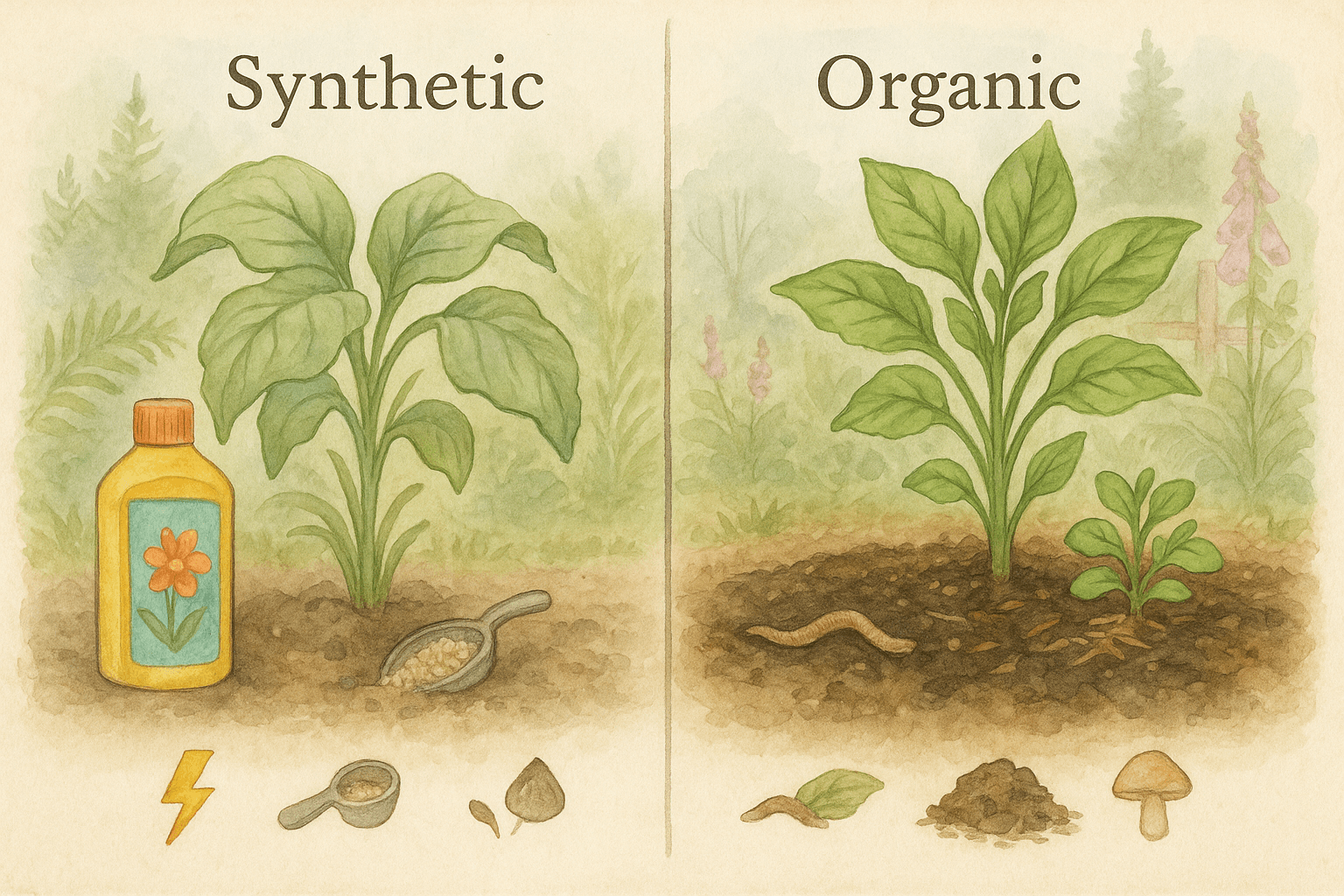
Synthetic Fertilizers: The Fast Food of the Garden
What they are:
Highly soluble, lab-made forms of nitrogen, phosphorus, and potassium (N-P-K) designed for instant uptake.
Pros
Immediate results (green-up in days)
Precise control of N-P-K ratios
Useful for very specific deficiencies
Helpful in containers where nutrients wash out quickly
Cons
Don’t improve soil structure
Can burn plants if overapplied
Feed plants but starve the soil microbiome
Increase dependency — plants “expect” constant refills
Can contribute to nutrient runoff (algae blooms, etc.)
The science bit:
Synthetic nitrogen bypasses the soil food web entirely. Plants absorb it immediately, but the microbial community that normally cycles nitrogen gets outcompeted or dies back. Over time, the soil becomes biologically quiet — like a forest with no animals. Plants grow, yes, but the ecosystem that supports them weakens.
Organic Fertilizers: Whole-Food Nutrition for Soil
What they are:
Compost, worm castings, manures, kelp meal, alfalfa meal, feather meal, fish hydrolysate — slow-release materials that break down through microbial action.
Pros
Improve soil structure and water retention
Feed soil life, not just plants
Provide micronutrients synthetics totally lack
Reduce disease pressure by supporting beneficial microbes
Release nutrients naturally as plants need them
Build long-term fertility
Cons
Slower results (days–weeks instead of hours)
Nutrient levels vary
Can require more volume
In very poor soil, sometimes need a little synthetic “starter” while biology recovers
The science bit:
Organic matter fuels the soil food web — fungi, bacteria, protozoa, nematodes. These tiny workers convert raw material into stable humus and plant-available nutrients. The more biologically active your soil, the less you need to add over time.
Healthy soil = self-feeding soil.
So… Which Should You Use?
My Odd Garden take: go organic first, always.
But don’t shame yourself if you’ve occasionally reached for a synthetic boost — most of us have. The trick is understanding the long game.
Use synthetic fertilizers for:
Containers that leach nutrients fast
Seedlings that need a teeny, diluted bump
Emergency corrections (e.g., clear nitrogen deficiency)
Use organic fertilizers for:
Beds, borders, shrubs, perennials, trees
Food gardens
Soil that needs rebuilding
Anyone who wants long-term fertility and fewer inputs year after year
The Best Organic Solutions (PNW-Friendly)
1. Compost (the cornerstone)
Adds organic matter, micronutrients, and microbial diversity.
In PNW clay-leaning soils, compost is magic.
2. Worm Castings
A teaspoon has billions of microbes.
Great for seedlings, houseplants, and tired soil.
3. Kelp Meal or Liquid Kelp
Contains growth hormones, trace minerals, and stress-reducing compounds.
Fantastic for roots.
4. Fish Hydrolysate (liquid)
A gentle N boost + microbial food.
Smelly for 20 minutes, worth it forever.
5. Alfalfa Pellets
Slow-release nitrogen + triacontanol, a natural growth stimulant.
6. Leaf Mold (underrated superhero)
Retains water, creates fluffy soil, and hosts powerful fungi.
7. Aged Manure
Adds steady nutrients and organic matter.
(Use aged, not fresh, around veggies.)
The Real Question Is: Do You Want to Feed the Plant… or the Soil?
Synthetic fertilizers are like giving your plant a quick sugary drink before a run.
Organic fertilizers are like training its entire system — bones, muscles, gut, resilience.
One gives you speed.
The other gives you strength.
Your garden, your call.
But in the Odd Garden?
We’re always rooting for the long, slow magic of healthy soil.
Related reads
A few more posts that pair well with this one.
Slugs in the Garden: What They’re Really Doing Here
→Slugs thrive in Western Washington’s damp climate. Learn when slug season starts and natural PNW slug control methods that actually work.
The Garden Is Not Sleeping: What’s Actually Happening in January
→Your garden isn’t asleep in January. Discover the quiet work happening underground, from roots and buds to soil life and winter wildlife.
The Quiet Magic of Seeds (and Why Plants Feel Like Wizards)
→Seeds are tiny packets of quiet intelligence. Plants literally build themselves out of air, respond to touch, make sounds, and use clever tricks to attract pollinators. A whimsical dive into the magic and science of how plants grow.
Not finding the answers?
Have a gardening question or topic you'd like me to write about? Send a request and I'll see what I can dig up.
Enjoying this post?
If you love the whimsy and want to support more PNW garden guides, you can buy me a coffee.
🌼 Buy Me a Coffee