PNW Frost Dates (A Gentle Guide)

Understanding first frost, last frost, and the quiet shifts happening in our Pacific Northwest gardens.
If you’ve gardened in the Pacific Northwest for more than a season or two, you’ve probably noticed this: our frost dates feel less like hard rules and more like soft suggestions. The PNW is a land of salty coastal breezes, foggy valleys, unexpected warm pockets, and little saddles of cold air that settle unpredictably.
And yet—knowing your frost dates is still one of the most helpful bits of garden wisdom you can keep in your pocket. Think of them less as deadlines and more like a gentle weather story your garden tells you each year.
Let’s take a cozy walk through it.
Why Frost Dates Matter (But Don’t Panic…)
Frost dates help you decide when to tuck plants in for winter, when to sow seeds, and when your tomatoes can finally move out of the house and into their real beds.
But here’s the truth: even your next-door neighbor can have different frost patterns. A yard with a south-facing fence warms earlier. A low, bowl-shaped lawn traps cold air. Raised beds heat faster than the ground.
Frost dates are less “instructions” and more “helpful hints.” And that’s the best way to read them.
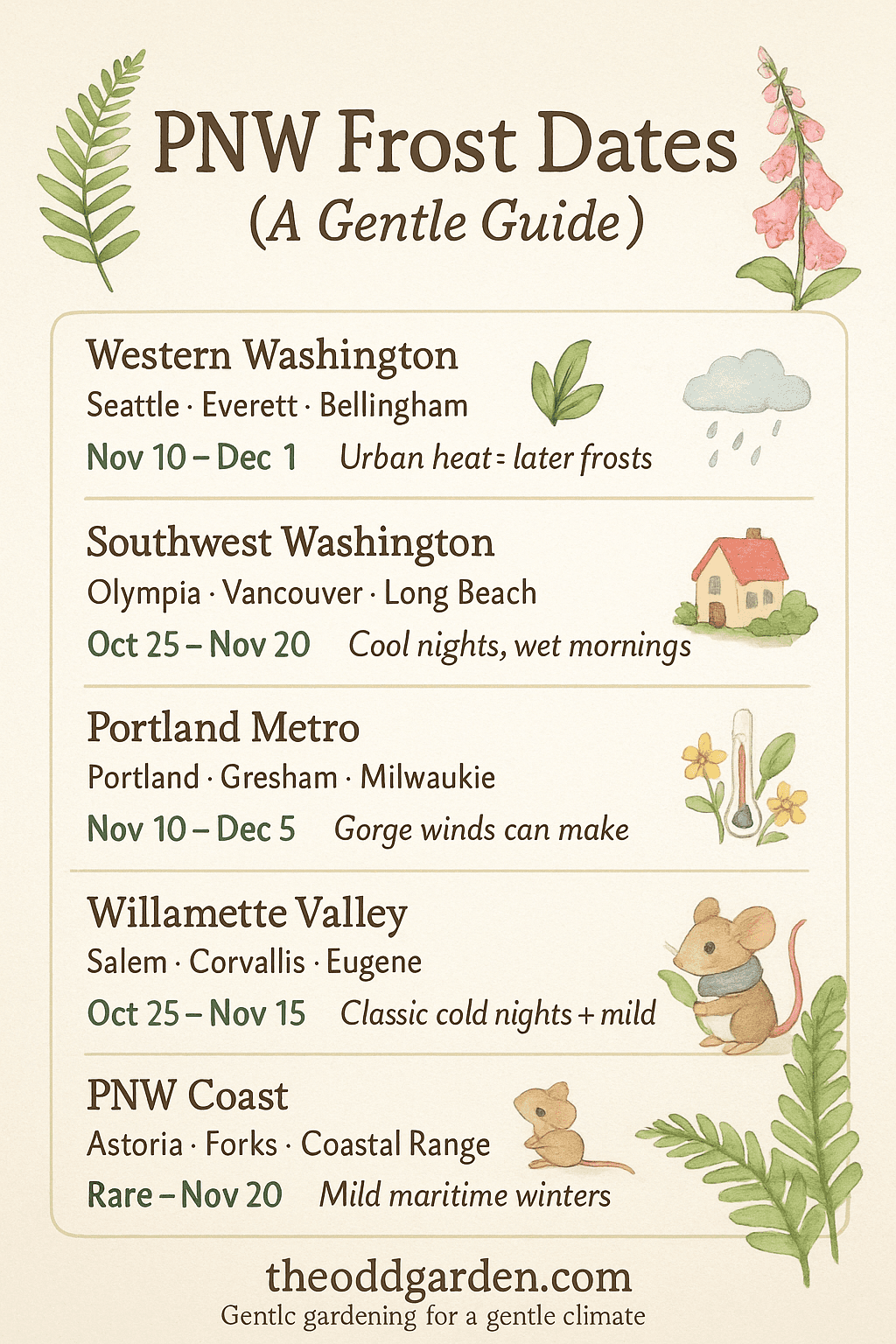
PNW First & Last Frost Windows (2025 Update)
Rounded averages based on NOAA climate normals + the microclimate magic of our region.
Western Washington
(Seattle, Everett, Bellingham)
First frost: Nov 10–Dec 1
Last frost: Feb 20–Mar 20
Urban gardens often go even later thanks to heat-retaining buildings and pavement.
Southwest Washington
(Olympia, Vancouver, Long Beach)
First frost: Oct 25–Nov 20
Last frost: Feb 15–Mar 10
Portland Metro
First frost: Nov 10–Dec 5
Last frost: Feb 20–Mar 25
The gorge influence can bring surprise cold snaps even after mild spells.
Willamette Valley
(Salem, Corvallis, Eugene)
First frost: Oct 25–Nov 15
Last frost: Feb 10–Mar 10
Cool nights, warm days, and inversion layers = classic valley behavior.
PNW Coastal
(Forks, Astoria, the Coast Range)
First frost: Rare to Nov 20
Last frost: Late Jan–mid Feb
Coastal gardeners live a charmed, misty, frost-light life.
A Few Gentle Warnings
Because frost isn’t always dramatic—sometimes it’s barely a whisper.
Microclimates matter more than zip codes.
A fence, a slope, a cluster of conifers, a patio stone—it all affects heat retention.
Climate change is shifting frost dates later.
Across much of the PNW, the “first frost” is drifting deeper into November or even December. Don’t be surprised if your garden feels different year to year.
A tiny frost won’t ruin everything.
Garlic, kale, collards, many root veggies—they actually sweeten after frost.
Your dahlias, basil, and tomatoes, however, prefer a soft goodbye before the cold hits.
How to Track Your Own Frost Pattern (Easily!)
You don’t need fancy gear—just a bit of curiosity.
Put a simple outdoor thermometer at plant level, not the deck railing.
Notice where dew lingers the longest—these are your frost pockets.
Watch how frost forms: lawns frost first, raised beds frost last.
When in doubt, take quick morning photos of frost days.
Over a season, you’ll have your very own Frost Journal.
PNW Frost Dates (A Gentle Guide)
Practical Planting Tips for Frost Season
Fall & Winter
Plant garlic 2–4 weeks before first frost.
Mulch dahlias once their leaves blacken from the first frost.
Bring in tender herbs before nighttime temps dip below 35°F.
Protect fall seedlings with row cover—it’s like a tiny quilt.
Spring
Start seeds inside while frosts are still happening.
Tomatoes, dahlias, squash → transplant after the last frost and when soil is 55–60°F.
Peas, radishes, lettuce → these can go out much earlier; they love cool soil.
Keep floating row cover ready for rogue April cold snaps.
A Bit of Garden Magic: Frost as a Teacher
Frost teaches patience.
It reminds us that growth isn’t always visible.
It gives the soil time to settle and the gardener time to breathe.
In the PNW, where our winters are more whisper than roar, frost is less of a battle and more of a seasonal nudge. A reminder that the garden is alive, resting, and preparing—just like we are.
If You Only Remember One Thing…
Your garden’s frost dates are unique to your little patch of the world.
Let them guide you, but don’t let them boss you around.
Pay attention, stay curious, and trust what your garden is always whispering back.
Related reads
A few more posts that pair well with this one.
Pacific Northwest Gardening Calendar (Zone 8a–8b)
→A month-by-month Pacific Northwest gardening calendar for Zone 8a–8b. What to plant, prune, and watch for in real PNW conditions.
The 10 Plants That Thrive on Neglect
→Looking for low-maintenance plants? These 10 hardy favorites tolerate drought, poor soil, and a little neglect—perfect for busy gardeners in the Pacific Northwest.
Garden Mistakes I Still Make Every June
→Even experienced gardeners make mistakes. Here are the common June gardening mistakes I still catch myself making in the Pacific Northwest—and what I'm trying to do differently.
Not finding the answers?
Have a gardening question or topic you'd like me to write about? Send a request and I'll see what I can dig up.
Enjoying this post?
If you love the whimsy and want to support more PNW garden guides, you can buy me a coffee.
🌼 Buy Me a Coffee