

Horsetail: The Prehistoric Plant That Won’t Quit
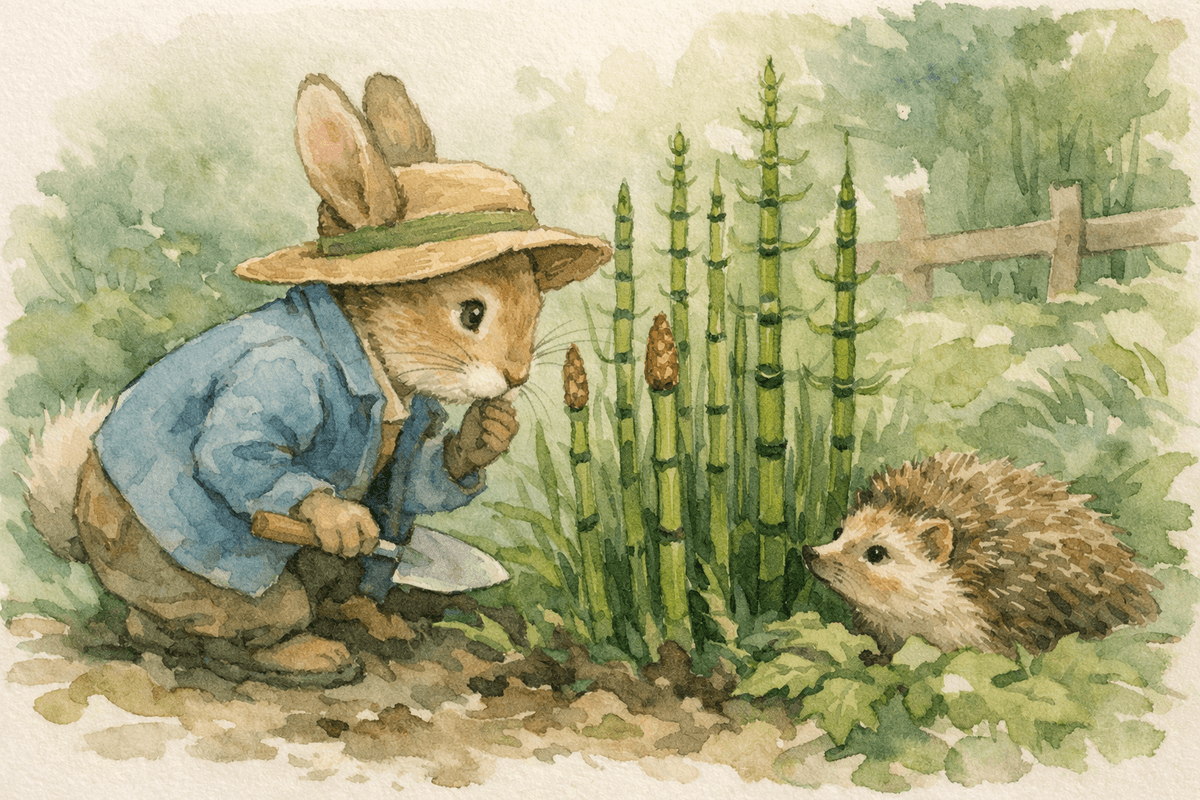
If you’ve ever pulled a strange, bamboo-like weed that snaps into little segments…
you’ve likely met horsetail (Equisetum).
It’s ancient—older than dinosaurs—and once grew as tall as trees.
Today, it quietly pushes up through garden beds, paths, and even raised planters with stubborn persistence.
And here’s the frustrating part:
You can improve your soil, plant beautifully, mulch generously…
and it can still appear.
How to Identify Horsetail
Look for:
Thin, upright green stems (no true leaves)
Distinct joints or “segments”
A rough, almost sandpapery texture
In spring: pale brown shoots with cone-like tips (spores)
It often shows up in:
Compacted soil
Poor drainage
Older, undisturbed ground
…but not only there (more on that in a moment).
Why It’s So Hard to Get Rid Of
Horsetail survives because it plays by different rules:
Deep rhizomes → roots can go several feet down
Underground spread → it can travel unseen
High silica content → tough, resistant stems
Ancient survival strategy → it’s built to persist
It’s less a simple weed… and more a long-term resident.
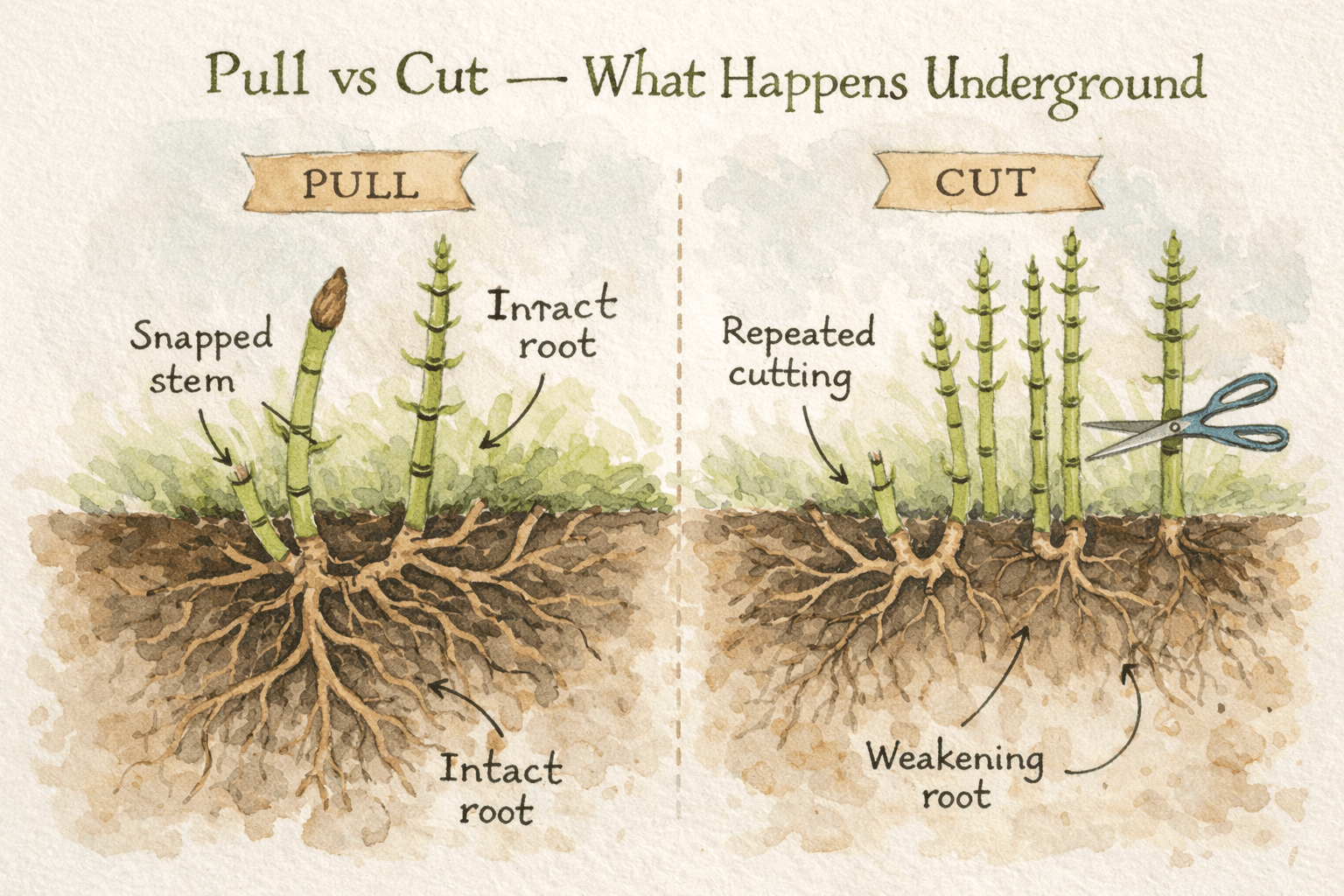
Pulling vs Cutting (This Changes Everything)
Most gardeners instinctively pull horsetail.
❌ Pulling / snapping:
Breaks the stem at the joints
Leaves the root system untouched
Can trigger more shoots
✅ Cutting back (the real strategy):
Snip at soil level
Don’t disturb the roots
Repeat consistently
Why it works:
Each cut removes the plant’s ability to photosynthesize—
slowly draining the energy stored underground.
Think of it as exhaustion over time, not instant removal.
Fix the Conditions (But Here’s the Truth)
Yes—improving soil helps:
Loosen compaction
Add compost
Improve drainage
And this does matter.
But here’s the part most guides don’t tell you:
Even in perfect soil… horsetail can still appear.
Why You’re Still Seeing It (Even in Healthy Beds)
If you’ve:
improved your soil
added compost
planted densely
…and you still see the occasional shoot—even in a raised bed—
this is normal.
Horsetail can:
Send shoots up from deep underground roots
Creep in from neighboring areas
Push through mulch and planting
This doesn’t mean your soil is failing.
The Most Important Distinction
There are two very different situations:
Thriving horsetail
Dense patches
Spreading quickly
Thick, vigorous growth
Residual horsetail
Occasional shoots
Scattered, not spreading
Easy to remove
If you’re seeing the second one…
You’re already winning.
What About Neighbors?
If a neighboring yard has horsetail, it can:
Spread underground
Reappear along boundaries
Pop up in new spots
But here’s the key:
It only
thrives
where conditions suit it.
Your improved garden is already resisting it.
What helps:
A mulched, well-managed edge strip
Cutting shoots quickly at boundaries
(Optional) a root barrier for persistent areas
What to Do Now (The Endgame)
At this stage, the strategy is simple:
1. Cut it when you see it
Quick snip. No digging. No drama.
2. Stay consistent
You’re weakening the root system over time.
3. Don’t redo your soil
You’ve already done the hard work.
4. Keep planting densely
Healthy plants are your best defense.
What About Herbicides?
You’ll often see advice to spray horsetail with herbicides.
And to be fair—they can have some effect.
But personally, I don’t use them in the garden.
Why I Skip Chemicals for Horsetail
They’re inconsistent
Horsetail’s silica-rich stems make it hard for sprays to absorb properly.
They rarely solve the root problem
The deep rhizomes often survive and send up new shoots.
They don’t fit a planted garden well
In mixed beds, it’s easy to damage nearby plants.
The Bigger Picture
By the time horsetail is just:
a few scattered shoots
easy to snip
not spreading
You’ve already done the hard work.
At that point, spraying is often:
more effort… for not much more gain.
What Success Actually Looks Like
With horsetail, success isn’t:
“it never appears again”
It’s:
“it shows up occasionally—and I deal with it in seconds”
Odd Garden Note
Horsetail humbles almost every Pacific Northwest gardener at some point.
If it’s:
sparse
manageable
not spreading
Then your garden isn’t losing.
It’s quietly taking control.
There’s no judgment here—every garden is different.
But in a healthy, living garden,
I’ve found it’s usually better to work with the system than try to force it.
A pair of snips and a bit of consistency tends to win out in the end.
Related reads
A few more posts that pair well with this one.
Cover Crops for Pacific Northwest Gardens: Protect and Improve Your Soil Over Winter
→Discover the best fall cover crops for Pacific Northwest vegetable gardens, when to plant them, and how to improve your soil naturally over winter.
The Odd Garden Guide to Aphids on Roses
→Tiny green invaders on your roses? Learn how to control aphids naturally using water, beneficial insects, and simple home methods—no harsh chemicals needed.
Slugs in the Garden: What They’re Really Doing Here
→Slugs thrive in Western Washington’s damp climate. Learn when slug season starts and natural PNW slug control methods that actually work.
Not finding the answers?
Have a gardening question or topic you'd like me to write about? Send a request and I'll see what I can dig up.
Enjoying this post?
If you love the whimsy and want to support more PNW garden guides, you can buy me a coffee.
🌼 Buy Me a Coffee