When and How to Prune Rhododendrons in the Pacific Northwest
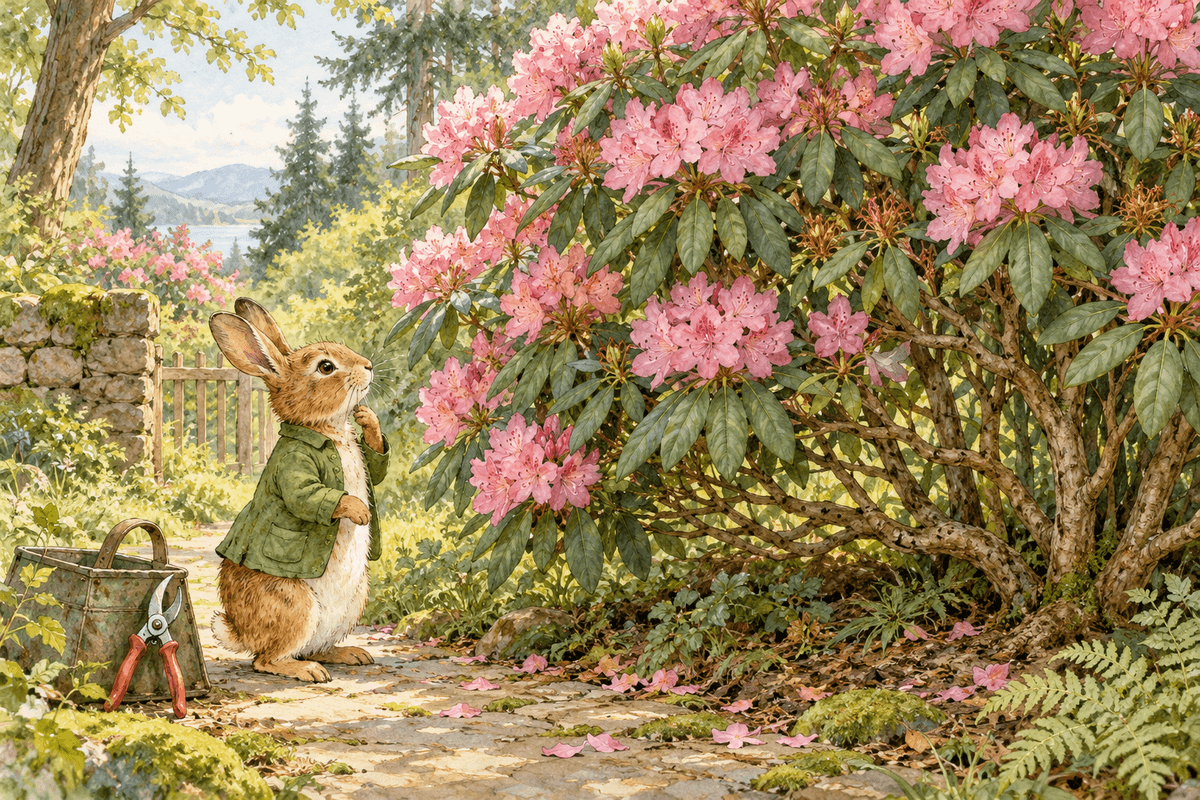
The right way to shape, rejuvenate, and care for your rhododendrons without sacrificing next year's flowers.
Rhododendrons are one of the great pleasures of gardening in the Pacific Northwest. Every spring, their enormous clusters of pink, purple, red, and white flowers brighten gardens that have spent months beneath gray skies.
But given enough time, these beautiful shrubs can become rather unruly.
Branches stretch across pathways, lower stems become bare, and what was once a compact flowering shrub gradually transforms into something resembling a small tree.
The good news? Rhododendrons are surprisingly forgiving plants. With the right approach, even an old, overgrown specimen can often be brought back under control.
The secret is knowing when to prune, where to cut, and how much to remove.
When is the best time to prune rhododendrons?
The best time to prune most rhododendrons is immediately after they finish flowering, typically May through June in western Washington, depending on the variety and spring weather.
Why does timing matter?
Rhododendrons generally develop their flower buds for the following spring during the previous growing season. If you prune too late in summer or autumn, you risk removing those buds before they ever have a chance to bloom.
Season | Pruning recommendation |
|---|---|
Spring, before flowering | Remove dead, damaged, or diseased wood |
Late spring–early summer | Best time for shaping and routine pruning |
Mid–late summer | Avoid substantial pruning; flower buds are developing |
Fall | Avoid routine pruning |
Winter | Remove hazardous or broken branches; defer major work |
A Pacific Northwest tip: October may feel like an ideal time to tidy the garden, but it's generally the wrong time to reshape a rhododendron. By autumn, next spring's flower buds are usually already present.
If your rhododendron is healthy, leave it alone until flowering finishes next year.
Do rhododendrons actually need pruning?
Not necessarily.
Unlike roses or some other flowering shrubs, rhododendrons don't require annual pruning to remain healthy or produce flowers.
In fact, many look their best when allowed to develop their natural, somewhat irregular shape.
Pruning is most useful when:
The shrub has become too large for its location.
Branches are blocking paths, windows, or other plants.
Dead or damaged branches need removing.
The plant has developed a sparse, leggy appearance.
You want to encourage denser, more compact growth.
The goal shouldn't be to force every rhododendron into a perfect rounded ball. Their natural structure is part of their charm.
Three ways to prune a rhododendron
Not all pruning is the same. The approach you choose should depend on what you're trying to achieve.
1. Deadheading
Removing spent flower clusters after blooming can improve appearance and prevent seed production. It is optional, particularly on large established shrubs.
2. Maintenance pruning
Selectively shortening branches helps maintain a manageable size, improves structure, and encourages branching.
3. Rejuvenation pruning
More substantial cuts can restore an old, leggy shrub, although recovery may take several growing seasons.
How to deadhead rhododendrons
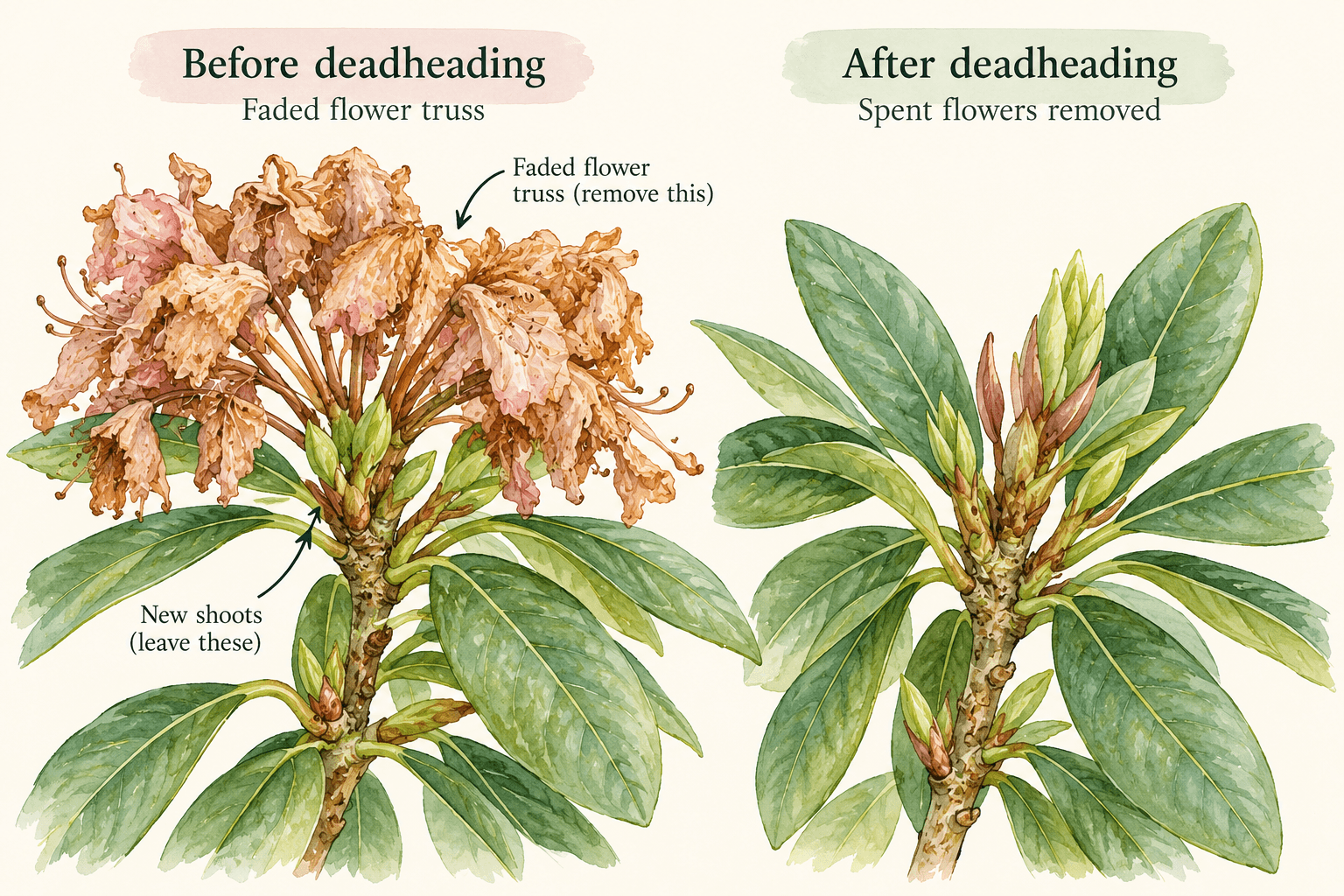
After flowering, rhododendrons often retain large clusters of faded, papery blooms.
These spent flower clusters, called trusses, can be removed to improve the shrub's appearance.
To deadhead:
Locate the faded flower cluster.
Hold the cluster near its base.
Carefully snap or cut it away without damaging the small developing shoots immediately beneath it.
Leave the surrounding leaves and new growth intact.
On smaller shrubs, deadheading can be a satisfying late-spring gardening task.
On a rhododendron that's twelve feet tall? Don't worry about it. Established plants generally flower perfectly well without deadheading.
How to prune a rhododendron to keep it compact
If your rhododendron is healthy but becoming a little too enthusiastic about occupying the garden, selective pruning is usually all that's necessary.
Start by stepping back and looking at the shrub's overall shape.
Rather than trimming the entire outside like a hedge, identify individual branches that extend too far.
Follow each branch inward until you reach a suitable side branch or a healthy leaf whorl (a cluster of leaves arranged around the stem).
Make your cut just above that point.
This encourages a more natural appearance and avoids leaving conspicuous bare stubs.
Avoid shearing rhododendrons into tight geometric shapes. Repeated shearing can produce dense outer growth, obscure the shrub's natural form, and remove developing flower buds.
Can you cut a rhododendron back hard?
Yes, sometimes—and this is where rhododendrons become particularly interesting.
Many established rhododendrons possess dormant buds beneath their bark. When older branches are cut back, these buds may activate and produce fresh shoots.
That means an old, woody rhododendron can sometimes regenerate from surprisingly substantial pruning.
However, not every rhododendron responds equally well. Species, cultivar, age, vigor, and growing conditions all affect the outcome.
For a valuable or particularly old specimen, gradual rejuvenation is the safer approach.
The three-year rejuvenation method
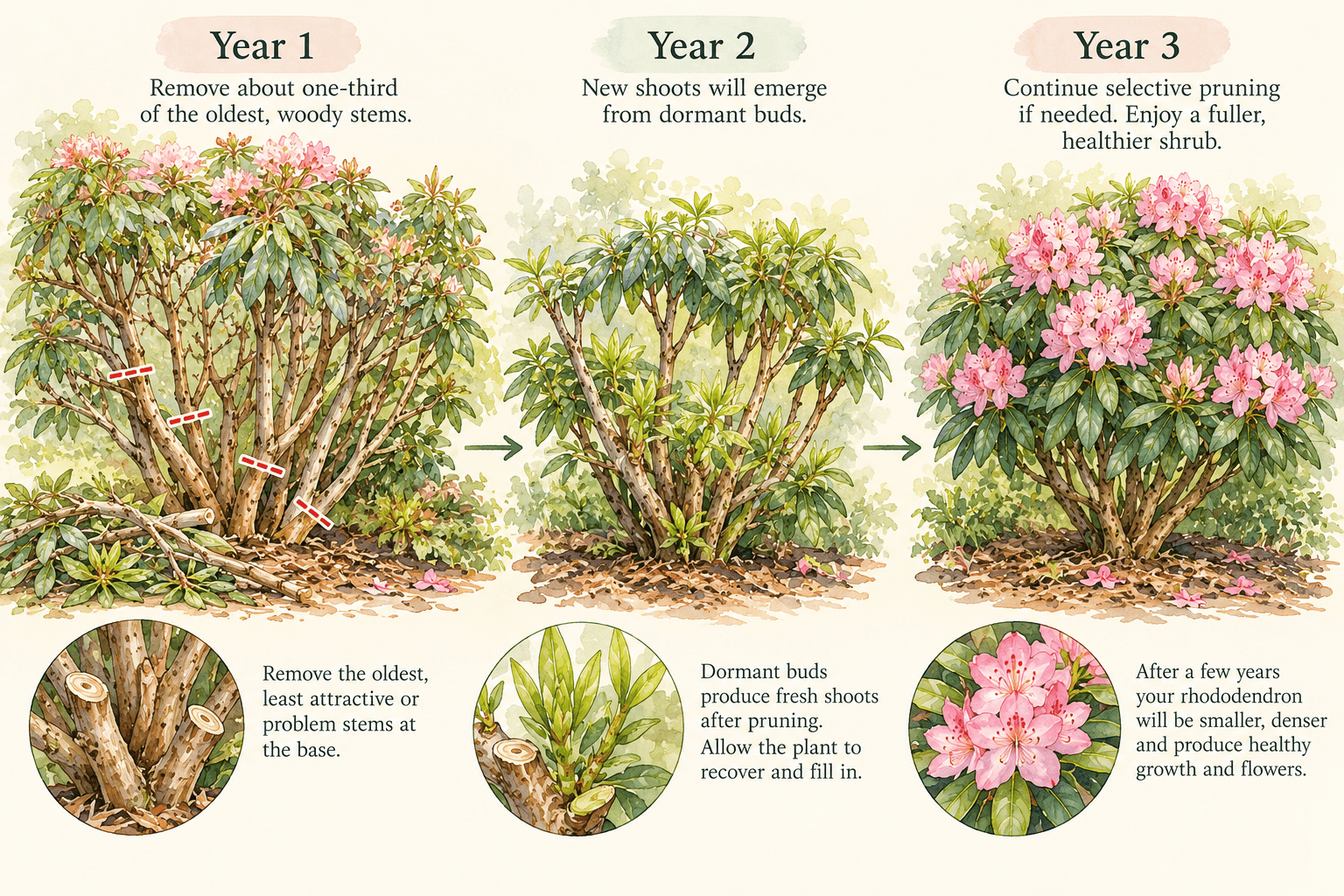
Year 1
Remove roughly one-third of the oldest problem stems.
Year 2
Assess regrowth and selectively remove more old wood.
Year 3
Finish reshaping if the plant has responded well.
Spread major pruning over several years rather than removing most of the foliage at once.
Begin with the oldest, least attractive, or most awkwardly positioned stems. Watch how the plant responds before making further cuts.
Some vigorous rhododendrons tolerate much more aggressive renovation, but severe pruning can leave a shrub bare for years or, in unfavorable conditions, cause substantial dieback.
It's also worth remembering that rejuvenation pruning often means sacrificing flowers temporarily while the plant rebuilds its structure.
Where exactly should you make the cut?
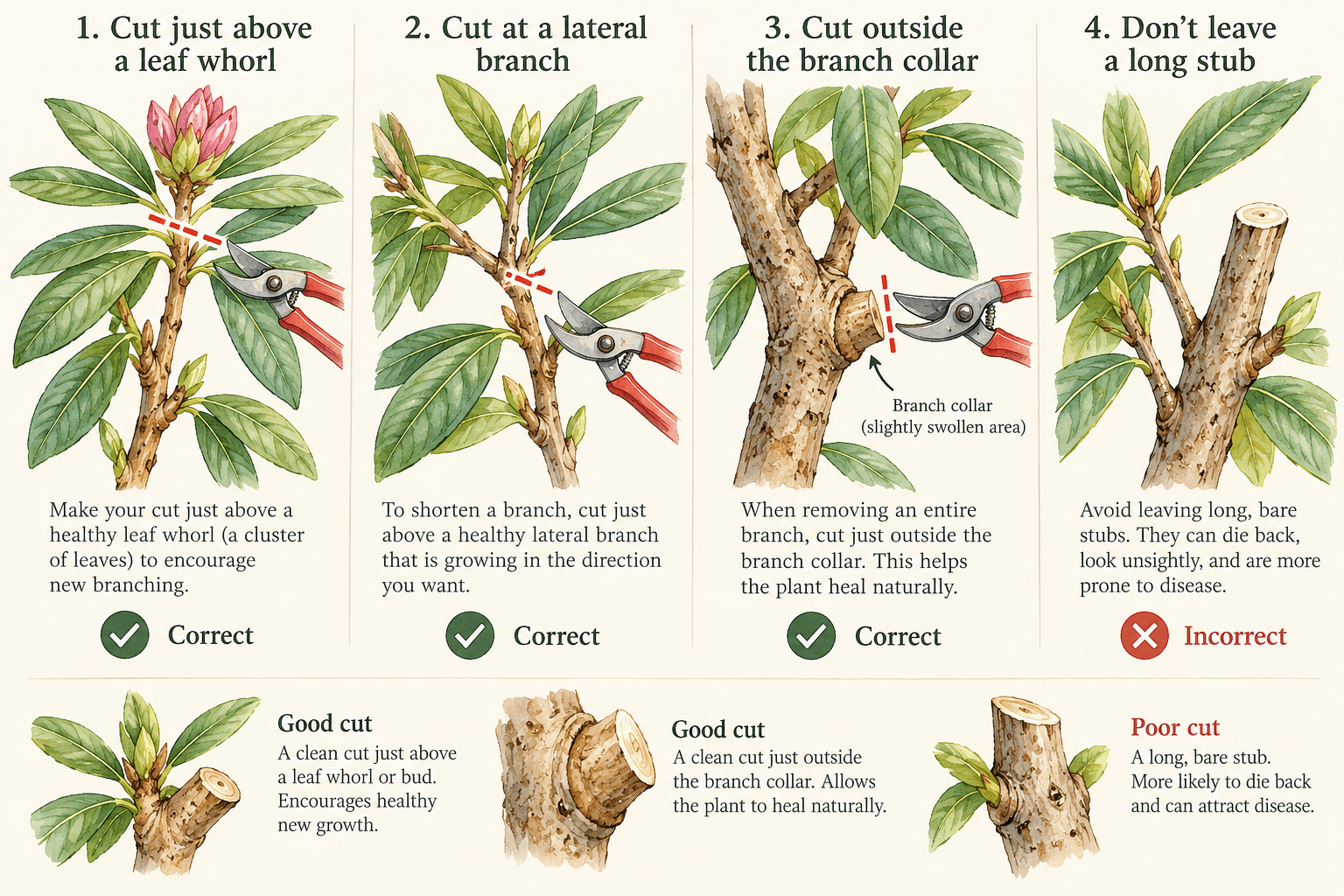
This is probably the most important practical detail.
For routine pruning, cut just above a healthy leaf whorl or suitable lateral branch, without damaging the remaining growth.
For removal of an entire branch, cut just outside the branch collar—the slightly swollen area where it joins a larger stem. Don't cut flush against the trunk.
Avoid leaving long, bare stubs, which may die back.
On old, leafless wood, new shoots depend on dormant buds. These are not always visible, and regrowth is less predictable than when pruning near healthy foliage.
A simple illustrated diagram showing the correct cutting points would be especially useful here.
Five common rhododendron pruning mistakes
Pruning in autumn.
This removes flower buds already formed for the following spring.
Cutting everything to the same height.
This creates an unnatural shape and may leave extensive bare wood.
Removing too much at once.
Severe pruning places considerable stress on an already struggling shrub.
Damaging new shoots while deadheading.
The delicate growth beneath faded flowers is easy to accidentally break.
Ignoring the plant's health.
A rhododendron struggling with drought, root problems, or poor drainage may not have the energy to recover from substantial pruning.
What to do after pruning
Rhododendrons have relatively shallow root systems, making them sensitive to prolonged dry conditions.
After substantial pruning, help the plant recover by maintaining good growing conditions.
Keep the soil evenly moist during dry weather, but avoid waterlogging it. Apply a layer of organic mulch, such as fine bark or leaf mold, around the root zone, keeping it away from the main stems.
Avoid applying heavy doses of fertilizer in an attempt to force rapid regrowth. A healthy rhododendron growing in suitable soil may not need fertilizer at all.
Most importantly, be patient.
Fresh shoots can take time to appear, particularly after cuts into old wood.
Frequently asked questions
- Can I prune rhododendrons in October?
You can remove dead, broken, or hazardous branches, but routine shaping should wait until immediately after flowering in spring. Fall pruning generally removes next year's flower buds.
- Will a rhododendron grow back if cut to the ground?
Some vigorous, established rhododendrons can resprout from old stems, but cutting a plant to ground level is risky and recovery is not guaranteed. Gradual rejuvenation is usually preferable.
- Why didn't my rhododendron flower after pruning?
You may have removed the flower buds, particularly if you pruned in late summer, fall, or winter. Heavy rejuvenation pruning can also delay flowering while the plant produces new vegetative growth.
- Should I remove dead rhododendron flowers?
Deadheading is optional. It can improve appearance and reduce seed production, but large established rhododendrons generally don't require it.
- How far back can I cut a rhododendron?
For routine shaping, prune back to healthy foliage or lateral branches. More aggressive cuts into old wood are possible on suitable plants, but should be approached cautiously because regrowth varies.
A final thought from The Odd Garden
There's something rather wonderful about an old rhododendron.
Its twisting branches and slightly eccentric shape tell the story of years spent growing in the same patch of earth.
It's tempting to approach such a plant with pruning shears and a determination to impose order.
But sometimes the best gardening decision is to remove a single awkward branch, step back, and leave the rest alone.
After all, a garden doesn't have to be perfectly tidy to be beautiful.
Further Reading & Resources
For more information on rhododendron care and pruning in the Pacific Northwest, these university extension services offer research-based gardening advice:
Oregon State University Extension
– Practical gardening guidance for Oregon and the Pacific Northwest.
Washington State University Extension
– Research-based horticultural information for Washington gardeners.
Related reads
A few more posts that pair well with this one.
What to Deadhead in June (And What to Leave Alone)
→Not sure which flowers to deadhead in June? Learn what to trim, what to leave alone, and how deadheading can keep your garden blooming longer in the Pacific Northwest.
How to Water a Garden Properly (PNW Beginner Guide)
→A simple beginner’s guide to watering your garden in the Pacific Northwest. Learn how often to water, signs of overwatering, and how to help plants grow stronger roots.
The 10 Plants That Thrive on Neglect
→Looking for low-maintenance plants? These 10 hardy favorites tolerate drought, poor soil, and a little neglect—perfect for busy gardeners in the Pacific Northwest.
Not finding the answers?
Have a gardening question or topic you'd like me to write about? Send a request and I'll see what I can dig up.
Enjoying this post?
If you love the whimsy and want to support more PNW garden guides, you can buy me a coffee.
🌼 Buy Me a Coffee